Poem
A free bird leaps
on the back of the wind
and floats downstream
till the current ends
and dips his wing
in the orange sun rays
and dares to claim the sky.
But a bird that stalks
down his narrow cage
can seldom see through
his bars of rage
his wings are clipped and
his feet are tied
so he opens his throat to sing.
The caged bird sings
with a fearful trill
of things unknown
but longed for still
and his tune is heard
on the distant hill
for the caged bird
sings of freedom.
The free bird thinks of another breeze
and the trade winds soft through the sighing trees
and the fat worms waiting on a dawn bright lawn
and he names the sky his own
But a caged bird stands on the grave of dreams
his shadow shouts on a nightmare scream
his wings are clipped and his feet are tied
so he opens his throat to sing.
The caged bird sings
with a fearful trill
of things unknown
but longed for still
and his tune is heard
on the distant hill
for the caged bird
sings of freedom.
Poetess

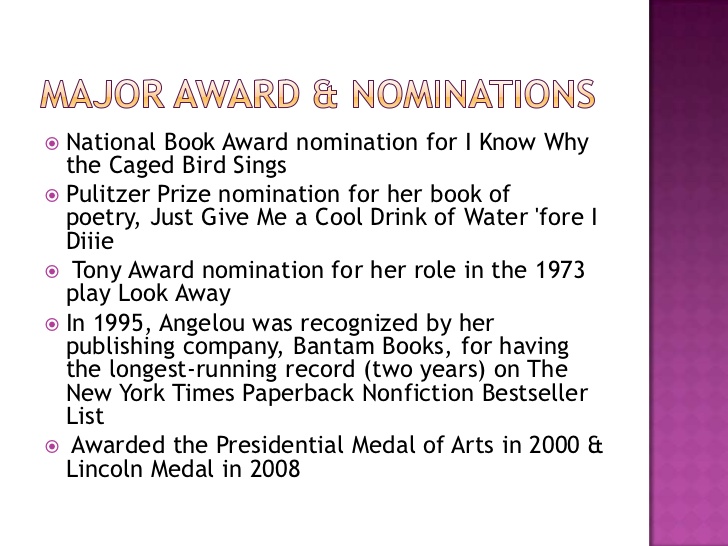
Marguerite Annie Johnson Angelou (April 4, 1928 to May 28, 2014), known as Maya Angelou, was an American author, actress, screenwriter, dancer, poet and civil rights activist best known for her 1969 memoir, I Know Why the Caged Bird Sings, which made literary history as the first nonfiction best-seller by an African-American woman. Angelou received several honors throughout her career, including two NAACP Image Awards in the outstanding literary work (non-fiction) category, in 2005 and 2009.
After experiencing health issues for a number of years, Maya Angelou died on May 28, 2014, at her home in Winston-Salem, North Carolina. The news of her passing spread quickly with many people taking to social media to mourn and remember Angelou. Singer Mary J. Blige and politician Cory Booker were among those who tweeted their favorite quotes by her in tribute. President Barack Obama also issued a statement about Angelou, calling her “a brilliant writer, a fierce friend, and a truly phenomenal woman.” Angelou “had the ability to remind us that we are all God’s children; that we all have something to offer,” he wrote.


Themes
Racism and Segregation

Maya confronts the insidious effects of racism and segregation in America at a very young age. She internalizes the idea that blond hair is beautiful and that she is a fat black girl trapped in a nightmare. Stamps, Arkansas, is so thoroughly segregated that as a child Maya does not quite believe that white people exist. As Maya gets older, she is confronted by more overt and personal incidents of racism, such as a white speaker’s condescending address at her eighth-grade graduation, her white boss’s insistence on calling her Mary, and a white dentist’s refusal to treat her. The importance of Joe Louis’s world championship boxing match to the black community reveals the dearth of publicly recognized African American heroes. It also demonstrates the desperate nature of the black community’s hope for vindication through the athletic triumph of one man. These unjust social realities confine and demean Maya and her relatives. She comes to learn how the pressures of living in a thoroughly racist society have profoundly shaped the character of her family members, and she strives to surmount them.
Debilitating Displacement
Maya is shuttled around to seven different homes between the ages of three and sixteen: from California to Stamps to St. Louis to Stamps to Los Angeles to Oakland to San Francisco to Los Angeles to San Francisco. As expressed in the poem she tries to recite on Easter, the statement “I didn’t come to stay” becomes her shield against the cold reality of her rootlessness. Besieged by the “tripartite crossfire” of racism, sexism, and power, young Maya is belittled and degraded at every turn, making her unable to put down her shield and feel comfortable staying in one place. When she is thirteen and moves to San Francisco with her mother, Bailey, and Daddy Clidell, she feels that she belongs somewhere for the first time. Maya identifies with the city as a town full of displaced people.
Maya’s personal displacement echoes the larger societal forces that displaced blacks all across the country. She realizes that thousands of other terrified black children made the same journey as she and Bailey, traveling on their own to newly affluent parents in northern cities, or back to southern towns when the North failed to supply the economic prosperity it had promised. African Americans descended from slaves who were displaced from their homes and homelands in Africa, and following the Emancipation Proclamation in 1862, blacks continued to struggle to find their place in a country still hostile to their heritage.
Resistance to Racism
Black peoples’ resistance to racism takes many forms in I Know Why the Caged Bird Sings. Momma maintains her dignity by seeing things realistically and keeping to herself. Big Bailey buys flashy clothes and drives a fancy car to proclaim his worth and runs around with women to assert his masculinity in the face of dehumanizing and emasculating racism. Daddy Clidell’s friends learn to use white peoples’ prejudice against them in elaborate and lucrative cons. Vivian’s family cultivates toughness and establishes connections to underground forces that deter any harassment. Maya first experiments with resistance when she breaks her white employer’s heirloom china. Her bravest act of defiance happens when she becomes the first black streetcar conductor in San Francisco. Blacks also used the church as a venue of subversive resistance. At the revival, the preacher gives a thinly veiled sermon criticizing whites’ charity, and the community revels in the idea of white people burning in hell for their actions.
Analysis
I Know Why the Caged Bird Sings by Maya Angelou is arguably one of the most moving and eye opening poems ever written. Angelou also wrote an autobiography with this same title, I Know Why the Caged Bird Sings. It is clear that this title had great significance to Angelou, as it was the title to her entire life story. In her autobiography, she talked about the struggle of being a black author and poet. She often felt that her words were not heard because of the color of her skin. She felt that in some ways, she was still experiencing slavery. Although African American people were free people in Angelou’s time, there were still many restrictions on them in society, making it so that many black Americans did not feel free at all. This poem, which can be read in full here, reveals the depth of those feelings.
First Stanza
She refers to nature. She describes the way “a free bird leaps on the back of the wind”. She describes the bird’s flight against the orange sky. The free bird has the right “to claim the sky”. The way she describes the “orange sun rays” gives the reader an appreciation for the natural beauty of the sky, and her description of the way the bird “dips his wing” helps the reader to appreciate the bird in his natural habitat, enjoying his freedom.
Second Stanza
This stanza is in stark contrast with the first. By using the word “but” to begin this stanza, the speaker prepares the reader for this contrast. Then she describes the “bird that stalks his narrow cage”. The tone is immediately and drastically changed from peaceful, satisfied, and joyful to one that is dark, unnerving, and even frustrating. She describes that this caged first “can seldom see through his bars of rage”. While the free bird gets to enjoy the full sky, the caged bird rarely even gets a glimpse of the sky. She claims that “his wings are clipped and his feet are tied”. Text from her autobiography reveals that Angelou often felt this way in life. She felt restricted from enjoying the freedom that should have been her right as a human being. The speaker then reveals that these are the very reasons that the bird “opens his throat to sing”.
The author felt this way in her own life. She wrote and sang and danced because it was her way of expressing her longing for freedom.
Third Stanza
The third stanza reverts back to the free bird, further cementing the difference between the free bird and the caged bird in the minds of the readers. She writes that a free bird thinks of another breeze” that he can enjoy the “sighing trees” and be free to find his own food. The tone with which she writes the first and third stanzas so sharply contrasts with the second stanza, that readers can feel the difference. The first and third stanzas give the reader a sense of ecstasy and thrill, which serve to make the second stanza seem all the more droll and even oppressive.
Fourth Stanza
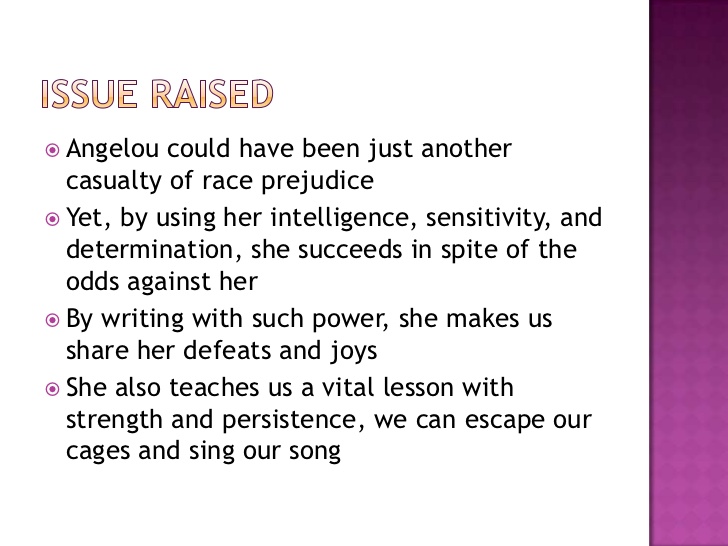
The fourth stanza continues the parallel between the free bird and the caged bird. The first line serves to starkly contrast the last line in the third stanza. It is dark and daunting. The reality of the life of the caged bird is revealed in this line. That bird, “stands on the grave of dreams”. This reveals the author’s feelings about her own dreams. She has so many dreams that have died because she was never given the freedom to achieve all that her white counterparts were able to achieve. Discrimination and Racism made up her cage, and although she sang, she felt her voice was not heard in the wide world, but only by those nearest her cage. The second line of this stanza in not only dark, but even frightening. The speaker describes the bird’s cries as “shouts on a nightmare scream”. At this point, the caged bird is so despondent in his life of captivity that his screams are like that of someone having a nightmare. The author then repeats these lines:
“His wings are clipped and his feet are tied, So he opens his throat to sing.”
Reaffirming the idea that the bird opens his mouth to sing because his desire for freedom and his desire to express himself cannot be contained.
Fifth Stanza
This last stanza focuses on the caged bird yet again. The author implies that even though the caged bird may have never experienced true freedom, deep down that bird still knows that it was created to be free. Although freedom, to the caged bird, is “fearful” because it is “unknown”, he still sings “a fearful trill” because he still longed for freedom. Here, the speaker reveals that his cry for freedom is “heard on the distant hill”. This parallels to the author and her cry for freedom in the form of equality. She feels that her cries are heard, but only as a soft background noise. She still feels that she is caged and that although she sings, her cries are heard only as a distant noise.
The last line states, “For the caged bird sings of freedom”. With this, the speaker implies that although the caged bird may never have experienced freedom, he still sings of it because he was created for freedom. This is paralleled to the African American struggle in Maya Angelou’s time. She feels that black Americans wrote and sang and danced and cried out for the freedom they deserved, but they were only heard as a distant voice. Yet, this would not stop them from crying out for freedom and equality because they knew they were made for freedom, and they would not relent until they were given their rights as human beings to enjoy the freedom they were created to enjoy.
Free bird symbolizes
In Maya Angelou’s poem “Caged Bird” she provides a juxtaposition a free bird’s life with that of a caged bird. The free bird symbolizes people who live in this world unencumbered by prejudice of any type whether it be racial, socioeconomic, or psychological.
Poetic Techniques
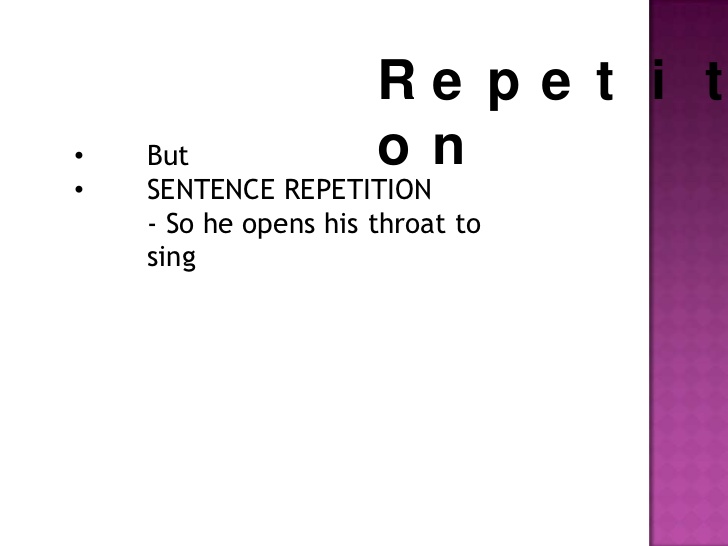
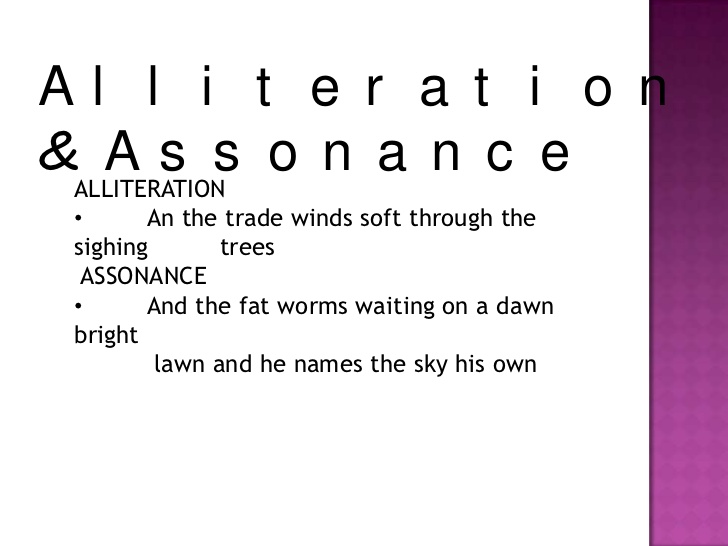
In “I Know Why the Caged Bird Sings,” Maya Angelou uses several poetic devices including alliteration, imagery, and symbolism. Alliteration, the repetition of consonant sounds, is used for emphasis on phrasing. An example from the poem includes “his shadow shouts on a nightmare scream”.


Imagery is used throughout Angelou’s work. Imagery is the author’s use of words to create a sensory experience for the reader. For example, “the caged bird sings with a fearful trill” helps us almost hear the unpleasant sound of the bird’s cry. Another example from the poem is “and the trade winds soft through the sighing trees” provides a more pleasant auditory experience for the reader.


Symbolism is an object or event in a poem that represents something beyond itself. Symbolism is the most powerful poetic device used in “Caged Bird.” Angelou’s contrast of the “free bird” and the “caged bird” represents humans who are “free” as opposed to “caged” in some way. The “caged” individuals may be held back by beliefs or fears or even others who are holding them back or enslaving them in some way. Angelou portrays the “free bird” as one who has the confidence to “claim the sky.” In contract, the “caged bird” is associated with “the grave of dreams” and “a nightmare scream”. Alliteration, imagery, and symbolism are all used by Angelou to create this classic poem.
 Literary Globe