Poem
THOU fair-hair’d angel of the evening,
Now, whilst the sun rests on the mountains, light
Thy bright torch of love; thy radiant crown
Put on, and smile upon our evening bed!
Smile on our loves, and while thou drawest the
Blue curtains of the sky, scatter thy silver dew
On every flower that shuts its sweet eyes
In timely sleep. Let thy west wind sleep on
The lake; speak silence with thy glimmering eyes,
And wash the dusk with silver. Soon, full soon,
Dost thou withdraw; then the wolf rages wide,
And then the lion glares through the dun forest:
The fleeces of our flocks are cover’d with
Thy sacred dew: protect them with thine influence!
William Blake

William Blake was born in London on November 28, 1757, to James, a hosier, and Catherine Blake. Two of his six siblings died in infancy. From early childhood, Blake spoke of having visions—at four he saw God “put his head to the window”; around age nine, while walking through the countryside, he saw a tree filled with angels. Although his parents tried to discourage him from “lying,” they did observe that he was different from his peers and did not force him to attend conventional school. He learned to read and write at home. At age ten, Blake expressed a wish to become a painter, so his parents sent him to drawing school. Two years later, Blake began writing poetry. When he turned fourteen, he apprenticed with an engraver because art school proved too costly. One of Blake’s assignments as apprentice was to sketch the tombs at Westminster Abbey, exposing him to a variety of Gothic styles from which he would draw inspiration throughout his career. After his seven-year term ended, he studied briefly at the Royal Academy.
In 1782, he married an illiterate woman named Catherine Boucher. Blake taught her to read and to write, and also instructed her in draftsmanship. Later, she helped him print the illuminated poetry for which he is remembered today; the couple had no children. In 1784 he set up a printshop with a friend and former fellow apprentice, James Parker, but this venture failed after several years. For the remainder of his life, Blake made a meager living as an engraver and illustrator for books and magazines. In addition to his wife, Blake also began training his younger brother Robert in drawing, painting, and engraving. Robert fell ill during the winter of 1787 and succumbed, probably to consumption. As Robert died, Blake saw his brother’s spirit rise up through the ceiling, “clapping its hands for joy.” He believed that Robert’s spirit continued to visit him and later claimed that in a dream Robert taught him the printing method that he used in Songs of Innocence and other “illuminated” works.
Blake’s first printed work, Poetical Sketches (1783), is a collection of apprentice verse, mostly imitating classical models. The poems protest against war, tyranny, and King George III’s treatment of the American colonies. He published his most popular collection, Songs of Innocence, in 1789 and followed it, in 1794, with Songs of Experience. Some readers interpret Songs of Innocencein a straightforward fashion, considering it primarily a children’s book, but others have found hints at parody or critique in its seemingly naive and simple lyrics. Both books of Songs were printed in an illustrated format reminiscent of illuminated manuscripts. The text and illustrations were printed from copper plates, and each picture was finished by hand in watercolors.
Blake was a nonconformist who associated with some of the leading radical thinkers of his day, such as Thomas Paine and Mary Wollstonecraft. In defiance of 18th-century neoclassical conventions, he privileged imagination over reason in the creation of both his poetry and images, asserting that ideal forms should be constructed not from observations of nature but from inner visions.
Blake’s final years, spent in great poverty, were cheered by the admiring friendship of a group of younger artists who called themselves “the Ancients.” In 1818 he met John Linnell, a young artist who helped him financially and also helped to create new interest in his work. It was Linnell who, in 1825, commissioned him to design illustrations for Dante’s Divine Comedy, the cycle of drawings that Blake worked on until his death in 1827.
Summary
In “To the Evening Star”, Blake maintains his Sketches theme of the daily cycle as metaphor to innocence and experience.
Specifically here, the speaker calls upon the “fair-hair’d angel of the evening” to protect him (all of us) against the evils of the night, and more importantly, inspire “whilst the sun rests” all that is oppressed during daytime.
The star represents the transcendent moments of struggle between oppositions.
It is a “bright torch” while all else is dark, presenting a juxtaposition thus transcendent symbol. In reality, the star is most likely the planet Venus, the Goddess of love and beauty, and helps build Blake’s motif of eroticism and desires that must remain hidden under the light of the omniscient day (notice the bed is “our” and not “mine” indicating it is a shared domain).
The speaker is beckoning Venus to bless the bed (some argue a bridal bed, although there is very little evidence elsewhere to support such notion) and to “smile on [their] love.”
But Venus cries “tears of dew” as she herself is aware of humankind’s fallen state on earth where sexual creativeness operates in a real of dangerous passions symbolized by savage beasts (the wolf and the lion).
Again we have a struggle of opposites here, this time symbolized through predator and prey that further builds up Blake’s theme of the cyclic and dialectic nature of the universe in which we live.
The speaker is young (as Blake himself was at the time) and his frustration between these opposing forces is placed on the table to deal with: youth and age, tyrant and slave, day and night, male and female, predatory and prey.
Structure and Rhyme Scheme
Sonnet with no rhyme scheme but has many internal rhymes, which could indicate the scattered nature of the ‘sacred dew’ of the morning, which act as symbols for ‘protect[ion]’
Title
A poem for Venus, Also called “The Evening Star”. You may want to google to know why it is called so!
Themes
- Love
- Nature
Analysis
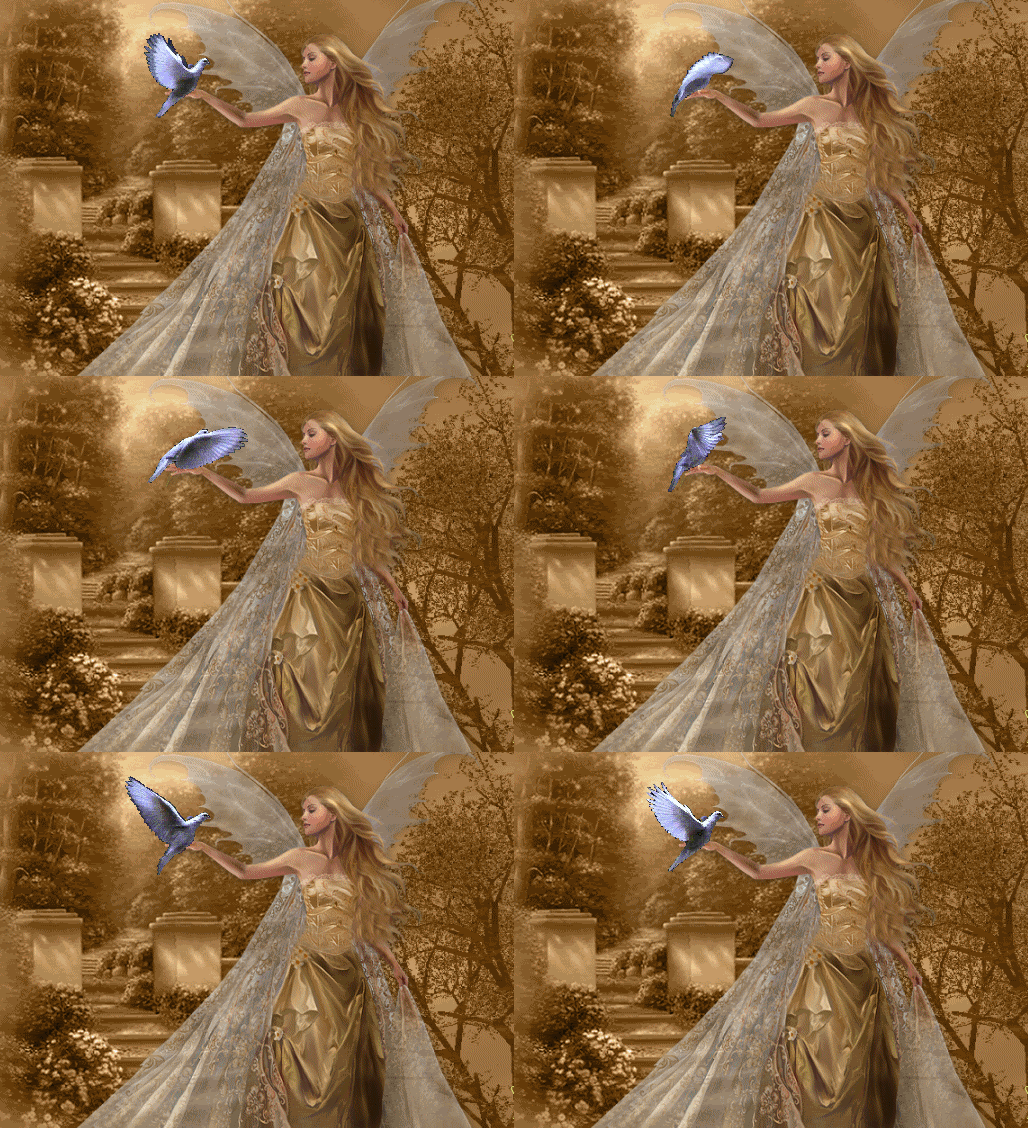
“fair-haired angel” — Personification of the star to something ethereal. Giving it both unearthly and earthly qualities. This develops the image of the star being something divine and therefore existing to aid and guide humans.
“light / Thy bright torch of love” — Enjambment. This showcases the way the light seeps throughout the land, by the sentence flowing into the next line without the use of punctuation. This torch is qualified as being ‘love’, and thus a positive quality is attributed to it.
“radiant crown” — A symbol of something magnificent.“Blue curtains of the sky” — Adding symbols to nature in order to develop landscape imagery and to show how the environment acts as per instruction of the star by relating it to something mundane and familiar, such as ‘curtains’.
“sweet eyes” — Personification of flowers. This is to add human qualities to the environment. This is to show the way Blake respects nature and therefore attributes it positive and respective terms. Sibilance in the repetition of ’s’ throughout the poem to indicate the soothing nature of the poem.
“west wind” — Alliteration here. This denotes an acoustic effect in the way the wind spreads through the poem, which is also showcased in the way that a particular rhyme scheme is not followed, but instead multiple internal rhymes are used.
“speak silence” — Another example of sibilance and alliteration. This is also an example of an oxymoron. This is done to contrast the two and highlight the magnificent power of the wind and sea, which is able to communicate something of ethereal quality without having to verbally say anything.
“glimmering eyes” — Personification and used to be able to imagine the dew with visual imagery by relating it to something familiar
“Soon, full soon,” — Repetition, and comma, used to show the longing in the poet’s voice, which is expected considering these words are at the end of the line and flows into the following line. Caesura used to show the way the wind may momentarily stop.
“wolf rages wide” — Personification.
“lion glares” — Personification.
“sacred dew” — Interesting use of the word sacred, which has transformed from dew to scared dew, perhaps by being blown in the light of the evening star, thereby attributing some holy quality to the tangible liquid. This may thus become a product of the star’s influence, therefore nature in itself is something that is influential and protects humans.
“protect them with thine influence” — This is Blake’s final wish: for the ‘sacred dew’/’venus’ to ‘protect’ (verb) the humans who depend on divine revelation.
Poetic techniques
METAPHOR
- Blue curtains of the sky
- Torch of love
- Angel of the evening
PERONIFICATION
- The sun rests
- Smile upon our evening bed
- Let thy west wind sleep on
- Speak slience with thy glimmering eyes
REPETITON
- Silver soon full soon
ALLITERATION
- Sky scatter thy silver dew
SYMBOL
- Wolf :- night
- Lion :- morning time
- Dun :- darkness
- Flocks :- innocent of people
DEIFICATION(Means attributing divine quality to something)
- Thy sacerd dew
- Protect them with thine inflences
ASSONANCE
- Whilst the sun rests on the mountains light.
INTERNAL RHYMIMING
- Light thy bright torch of love
- smile on our loves and while thou drawest
- blue curtains of the sky scatter thy silver dew
 Literary Globe