Poem
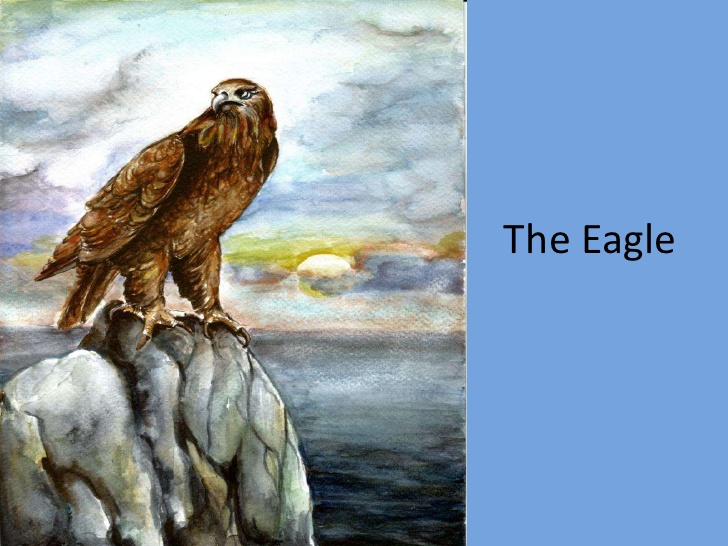
He clasps the crag with crooked hands;
Close to the sun in lonely lands,
Ringed with the azure world, he stands.
The wrinkled sea beneath him crawls;
He watches from his mountain walls,
And like a thunderbolt he falls.
Poet
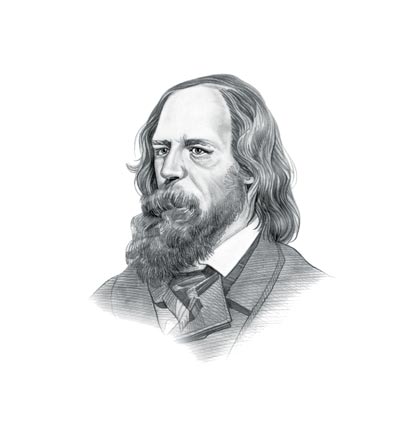
Alfred lord Tennyson was born on August 6, 1809, in Somersby, Lincolnshire, England, Alfred Lord Tennyson is one of the most well-loved Victorian poets. Tennyson, the fourth of twelve children, showed an early talent for writing. At the age of twelve he wrote a 6,000-line epic poem. His father, the Reverend George Tennyson, tutored his sons in classical and modern languages. In the 1820s, however, Tennyson’s father began to suffer frequent mental breakdowns that were exacerbated by alcoholism. One of Tennyson’s brothers had violent quarrels with his father, a second was later confined to an insane asylum, and another became an opium addict.
Tennyson escaped home in 1827 to attend Trinity College, Cambridge. In that same year, he and his brother Charles published Poems by Two Brothers. Although the poems in the book were mostly juvenilia, they attracted the attention of the “Apostles,” an undergraduate literary club led by Arthur Hallam. The “Apostles” provided Tennyson, who was tremendously shy, with much needed friendship and confidence as a poet. Hallam and Tennyson became the best of friends; they toured Europe together in 1830 and again in 1832. Hallam’s sudden death in 1833 greatly affected the young poet. The long elegy In Memoriam and many of Tennyson’s other poems are tributes to Hallam.
In 1830, Tennyson published Poems, Chiefly Lyrical and in 1832 he published a second volume entitled simply Poems. Some reviewers condemned these books as “affected” and “obscure.” Tennyson, stung by the reviews, would not publish another book for nine years. In 1836, he became engaged to Emily Sellwood. When he lost his inheritance on a bad investment in 1840, Sellwood’s family called off the engagement. In 1842, however, Tennyson’s Poems in two volumes was a tremendous critical and popular success. In 1850, with the publication of In Memoriam, Tennyson became one of Britain’s most popular poets. He was selected Poet Laureate in succession to Wordsworth. In that same year, he married Emily Sellwood. They had two sons, Hallam and Lionel.
At the age of 41, Tennyson had established himself as the most popular poet of the Victorian era. The money from his poetry (at times exceeding 10,000 pounds per year) allowed him to purchase a house in the country and to write in relative seclusion. His appearance—a large and bearded man, he regularly wore a cloak and a broad brimmed hat—enhanced his notoriety. He read his poetry with a booming voice, often compared to that of Dylan Thomas. In 1859, Tennyson published the first poems of Idylls of the Kings, which sold more than 10,000 copies in one month. In 1884, he accepted a peerage, becoming Alfred Lord Tennyson. Tennyson died on October 6, 1892, and was buried in Westminster Abbey.
About Eagle
Eagles. For centuries, these seemingly larger-than-life birds have fascinated and inspired us with brilliant leadership characteristics. When eagles come to mind, people commonly imagine some enormous hunter soaring above wide-open spaces on outsized wings. Indeed, eagles are among the world’s largest birds of prey. We venerate them as living symbols of power, freedom, and transcendence. In some religions, high-soaring eagles are believed to touch the face of God. Legend holds that Mexico’s Aztecs so revered the birds that they built Tenochtitlan, their capital, at the spot where an eagle perched on a cactus.
Man for many years have taken Eagles as a symbol of beauty, bravery, courage, honour, pride, determination and grace. What makes this bird so important and symbolic to humanity is its characteristics. Seven important characteristics of eagle has been closely associated to leadership and is widely researched and the facts accepted globally.
Eagles Flock Together. When they mix with other birds, they are there to find something to eat and then take off. – As the old saying goes, “Birds of like feathers flock together.” Eagles do not mix with other birds but only enjoy flying at their high altitude. It is this characteristic that makes eagles unique birds. An eagle will never surrender to the size or strength of its prey. It will always give a fight to win its prey or regain its territory. Go over and watch the video on how the Golden Eagle displays remarkable hunting strategy, preying on goats much larger than itself by throwing them off the cliff face. No matter what the size of that person or what weapon they maybe holding, you would attack them without thought or regard for yourself. It wouldn’t even dawn on you to be afraid because your instinct is to protect that which you love and cherish. Successful leaders are fearless. They face problems heard on.
Eagles See a Long Distance Prey or Enemy – Eagles have strong vision, so they can identify their prey and focus on it until they get it. At the same time, an eagle can see its enemy from afar, such as snakes trying to sneak in to its nest to steal its egg or to kill its young. Though eagles build their nests on high rocks and places, snakes have a tendency and ability to climb to them. But the strong vision of eagles keeps the enemies away from its nest. If you ever happen to see an eagle sitting high above the tree or cliff of a stiff mountain, watch closely and see how attentive the bird is. The body sits still and the head will be tilted side to side to observe what is happening below, around and above it. Even if its flying close by, you can observe how keen its eyes are looking for its prey. Eagles have a keen vision. Their eyes are specially designed for long distance focus and clarity. They can spot another eagle soaring from 50 miles away. Does this characteristic ring a bell in your mind? We are sure it does. Look at great leaders of this world who have come and gone. There are many great leaders that came and went but one characteristic that is common in all is “Vision”. Vision is a successful leadership characteristic. Take for Abraham Lincoln for example. Abraham, Lincoln, the 16th president of the United States, guided his country through the most devastating experience in its national history, the Civil War. He had a vision, to save the union and free the slaves. He is considered by many historians to have been the greatest American president. Everyone must have a vision that guides and leads his team towards the organization’s or societal goals. The vision must be big and focused. A big, focused vision will produce big results.
Eagles Do Not Eat Dead Things. – Eagles never consume dead things, but vultures do. Eagles can fly up to an altitude of 10,000 feet, but they are able to swiftly land on the ground. At 10, 000 feet, you will never find another bird. If you find another bird, it has to be an eagle according to Dr, Myles Munroe. An eagle doesn’t mingle around with the pigeons. It is Dr. Myles Munroe who said that. Pigeons scavenge on the ground and grumble and complain all day long. Eagles are not. They fly and make less noise waiting for opportunities to strike their next prey or glide with the current of the storm. Great leaders are problem solvers. They don’t complain like the pigeons do. They love to take challenges as the eagle does when the storm comes.
Eagles Love the Storm – Eagles are the only birds that love the storm. When all other birds try to flee from the storm and hide its fierceness, eagles fly into it and will use the wind of the storm to rise higher in a matter of seconds. They use the pressure of the storm to glide higher without having to use their own energy. They are able to do this because God has created them uniquely with an ability to lock their wings in a fixed position in the midst of the fierce storm winds. Challenges in the life of a leader are many. These are the storm we must face as leaders to rise to greater heights. Like an eagle, a leader can only rise to greater heights if he or she takes up the challenges head on without running away from it. Yet, another leadership characteristics.
Eagles Test Before Trusting – The female eagle during courtship always takes a male eagle into the air after picking up a twig from the ground and dropping it from a certain height for the male to chase it. Once the male catches hold of it and brings back, the female flies into a higher altitude and drops it in the same way. This is repeated until the female gets an assurance that the male has mastered the art of seriously picking up the twigs in real love and affection. Once they get hooked up in trust, the father and the mother eagle mate for life. They also work together as parents. On this note, believe this or not. Eagles are known for their aggression. They are absolutely ferocious aren’t they? Anyone who doesn’t have a total knowledge of this great bird will say yes. What is more astonishing with this bird is their ability to nurture their young ones. Research has shown that no member of the bird family is more gentle and attentive to its young ones than the eagles. This is how it happens. When the mother eagle sees that time has come for it to teach the eaglets to fly, she gathers an eaglet onto her back, and spreading her wings, flies high. Suddenly she swoops out from under the eaglet and allows it to fall. As it falls, it gradually learns what its wings are for until the mother catches it once again. The process is repeated. If the young is slow to learn or cowardly, she returns it to the nest, and begins to tear it apart, until there is nothing left for the eaglet to cling to. Then she nudges him off the cliff. True leaders are not bosses. They grow with their people. They strive to make individuals in the organization or society grow to their full ability. They teach and guide just like the mother eagle does. They never stop giving challenges but never give-up empowering and directing.
Summary
The poem has a very simple concept. It focuses on one eagle alone in the wild. In the first line, the eagle is atop a mountain, poised to strike. He is high up where no other animal or human can go. He is alone in his grandeur, with the sun and the bright blue sky forming the perfect background scenery.
The second stanza shows the only action of the eagle. The first and second line show that, as he watches from his high perch, the sea moves below him. Then, in the final line, the eagle makes a grand dive towards the sea. The poem ends here, with the reader not quite sure why the eagle dived off his mountain roost.
Analysis
This imagery poem by Alfred Lord Tennyson originates from his experiences while traveling as a young man in the Pyrenees. The poem was written before Tennyson was respected as one of the great poets of his time.
In his journals, Tennyson notes a valley, which he said was his favorite place in the world. This valley was in the Pyrenees where he was able to view the great predator of the skies: the eagle. Inspired to write about his sightings of the bird, Tennyson creates a single precise image of the bird looking down at a body of water.
The poet uses alliteration, personification, and a simile to enhance the reader’s experience of watching the bird. A very short poem but a great example of literary devices—this is Tennyson’s “The Eagle.”
1st Stanza
He clasps the crag with crooked hands
Close to the sun in lonely lands, Ringed with the azure world, he stands.
The poem begins by using alliteration to emphasize the stark and oddly shaped talons of the eagle: clasps, crap, crooked, and close.
The bird holds on to a rock with his oddly shaped claws. This would indicate that the eagle is high on a rocky mountain ledge.
The mountainous rock appears high up seeming to touch the sun. The place where the observer finds himself is far away from civilization: the lonely lands. The loneliness may also be a commentary on the life of the eagle as a solitary bird who lives and travels alone. The eagle magnificiently stands surrounded by the bluest sky.
2nd Stanza
The wrinkled sea beneath him crawls
He watches from his mountain walls,
And like a thunderbolt he falls.
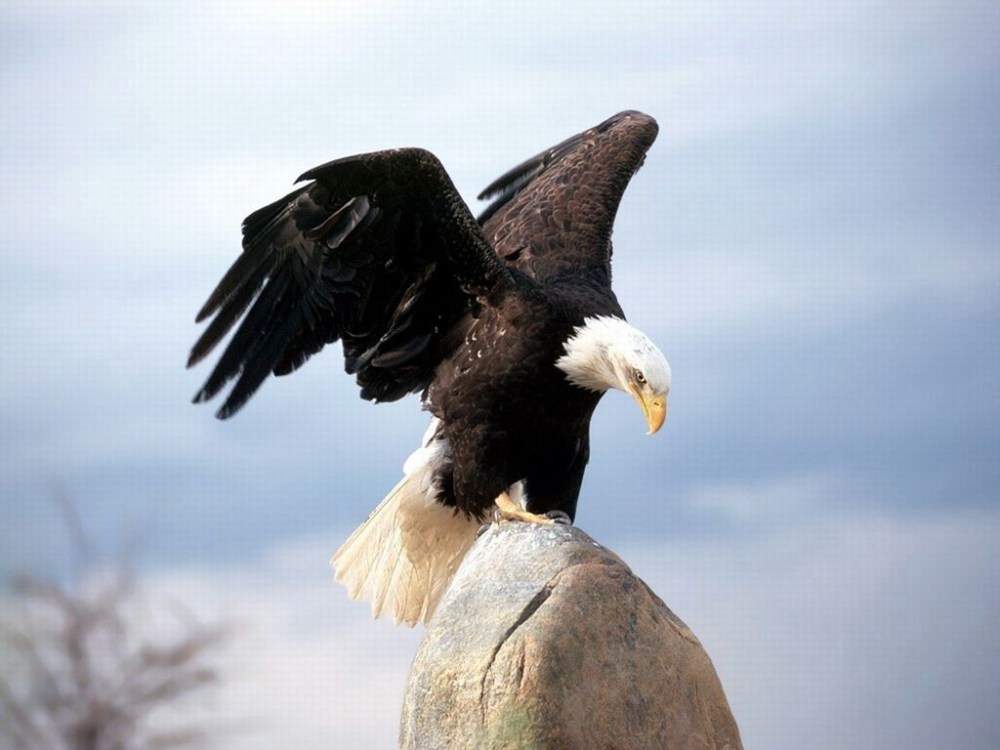
The observer must also be high enough to look down where he sees the water is moving and appears almost like it has wrinkles [both personification and a metaphor]. The water does not rush but rather crawls. The eagle also looks down from his lofty mountain rock and watches the water. He may be searching for a fish who is too close to the surface. Suddenly, just like a thunderbolt or lightning from the sky, he falls or soars into the sky [The perfect simile for the king of the skies].
The author encapsulates this tiny segment of nature: a majestic eagle diving from his lofty throne. Tennyson’s youthful image is forever memorialized with complete exactness.
 Literary Globe