Poem
He poured the coffee
Into the cup
He poured the milk
Into the cup of coffee
He added the sugar
To the coffee and milk
He stirred it
With a teaspoon
He drank the coffee
And put back the cup
Without speaking to me
He lit a cigarette
He blew some rings
With the smoke
He flicked the ashes
Into the ashtray
Without speaking to me
Without looking at me
He got up
He put his hat
On his head
He put on
His raincoat
Because it was raining
He went out
Into the rain
Without a word
Without looking at me
And I
I took my head
In my hands
And I wept.
Poet
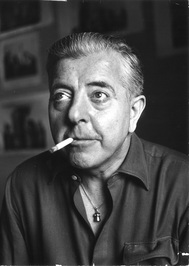
Jacques Prévert, (born Feb. 4, 1900, Neuilly-sur-Seine, Fr.—died April 11, 1977, Omonville-la-Petite), French poet who composed ballads of social hope and sentimental love; he also ranked among the foremost of screenwriters, especially during the 1930s and ’40s.
From 1925 to 1929 Prévert was associated with the Surrealists Robert Desnos, Yves Tanguy, Louis Aragon, and André Breton and renewed, in their style, the ancient tradition of oral poetry that led him to a highly popular form of “song poems,” which were collected in Paroles (1945; “Words”). Many were put to music by Josef Kosma and reached a vast audience of young people who liked Prévert’s anticlerical, anarchistic, iconoclastic tones, crackling with humour. He lashed out at stupidity, hypocrisy, and war, and he sang of lovers in the street and the metro and of simple hearts and children. Most popular is his Tentative de description d’un dîner de têtes à Paris-France (1931; “Attempt at a Description of a Masked Dinner at Paris, France”).
Prévert mastered the art of the small sketch that catches the reader off guard. He used free verse, irregular verse, occasional rhymes, puns, cascades of words intentionally in disarray, enumerations, antithesis, and other devices.
How thee conflict occured(In my view)
This poem does not contain a direct conflict. Rather, it contains a situation that obviously comes after some form of conflict, where the man who is eating his breakfast is choosing not to talk to the speaker of the poem.
The poem describes a typical breakfast scene in painstaking detail, including the making of a cup of coffee, the smoking of a cigarette, and the donning of a hat and raincoat. All of these are done without a word being said between the two characters, which creates an obvious atmosphere of tension throughout the poem, which culminates in the narrator’s tears after the man finishes his breakfast and leaves.
While we are not given any information as to the nature of the conflict that has taken place, the assumption is that it is between a husband and a wife. It is worth noting that, while the narrator is devastated by what has happened, she makes no effort to talk to the man while he eats his breakfast. The fact that neither of them attempt conversation implies that the conflict was serious
Critisism
The poem ‘Breakfast’ was published in 1945. It deals with a theme of conflicts that occur in communication in intimate relationships. Such conflicts could become painful especially when they occur at breakfast times, because it is a time intimate relationships clearly manifest. At breakfast times simple conversations take place where in the day’s proceedings too can be agreed upon. Most families start their days at breakfast table happily or with minimum conflicts, However, instances are there occasionally when a conflict is so strong, no communication would be possible. The poet has chosen such an instance as his topic
The poet here describes actions of a person as watched by another, the another of whom here could be the person’s wife. A visual image of the breakfast table is created first in which the man is seen along with a kinesthetic image of his pouring coffee into a cup ,Then more kinesthetic images are added to it as what that man does, ‘put milk put sugar’ ‘stirred it drank the coffee… and so on, all of which are in past simple tense.. However all that man does, is done without looking at or talking to his seemingly wife. The focus is on the man and what he does, while the woman is a passive watcher until the last three lincs where the focus turns to the wife

No auditory or tactile effect is made on the reader although the terms ‘stirring’ and ‘raining’ could cause some auditory effects on those who are sensitive to them. The woman is brought on the scene only in the last stanza wherein what she does is only weeping
‘And I, I put
my head in my hands
and wept’
The focus of the poem is on these last three lines which is the suffering of the woman. The images woven round it. The language contains simple nouns and verbs of simple past tense except for the verb form ‘was rainng’ in the third stanza. No adjectives or adverbs at all making the languagc simple, thus giving the value of simplicity to the poem.
The indifferent attitude of the man towards his wife is skillfully brought out without using adjectives or adverbs. The verb ‘put’ is used differently in all stanzas adding diversity too through uniformity.Almost all lines have 3 stresses while others have two, thus all are short lines. The poet clings to same short sentence structures strengthening the uniformity of form in it.
No feeling or emotion is seen at surface level until the last lines. When the last lines are reached all feelings of sorrow, despair and boredom appear as the time, waiting for an outlet to be released. Those emotions and feelings seem to have been working behind at sub-conscious levels in both of them. A state of silence is felt from the beginning, but such silence was really not there as seen in the last three lines.
The man’s state of confusion and giving outlets to his emotions is seen in his smoking and sending smoke rings, and the woman’s state of confusion is seen in the last three lines.

The poet does not make personal interference to convey his views on what’s happening
It appears, the poet wants the reader to think the way the reader likes. It could be, the man and the woman had an arguement or quarreled the previous day so they cannot talk to oneanother now.
It could also have been a trivial reason that caused, with no importance there in it, though the two of them feel it as great. It is up to the reader to feel the cause of conflict according to his or her background
Except for phrases ‘without talking ‘without looking’ and ‘without a word’ all others show actions. Thus a contrast is created there between what is done and what is not done.
In the final seeing, what is not done scems to have played the major role working at sub conscious levels of the two. Thus the poet has used a technique of conveying what is absent by presenting what is active, by keeping the real theme hidden behind instead of displaying it in the open. What occurs as subconscious states of mind have been presented by being detached with them
What this pocm describes could also be perfectly ‘normal human behavior in a morning. The communicative relationship between a man and a woman has ceased for sometime despite for their being in close physical proximity, to which there could have no grave reason to look for.
 Literary Globe