R.K Narayan

Among the contemporary Indian writers in English, Mr. R. K. Narayan stands supreme, “a star that dwelt apart.” As Professor Srinivasa Iyengar says, “He is a rare thing in India, a man of letters pure and simple.” R. K. Narayan was born in Madras, South India, and educated there and at Maharaja’s College in Mysore. His first novel Swami and Friends (1935) and its successor The Bachelor of Arts (1937) are both set in the enchanting fictional territory of Malgudi. Other ‘Malgudi’ novels are The Dark Room (1938), The English Teacher (1945), Mr. Sampath (1949), The Financial Expert (1952), The Man Eater of Malgudi (1961), The Vendor of Sweets (1967), The Painter of Signs (1977), A Tiger for Malgudi (1983), and Talkative Man (1986). His novel The Guide (1958) won him the National Prize of the Indian Literary Academy, his country’s highest literary honour. He was awarded in 1980 the A.C. Benson Medal by the Royal Society of Literature and in 1981 he was made an Honorary Member of the American Academy and Institute of Arts and Letters. As well as five collections of short stories, A Horse and Two Goats, An Astrologer’s Day and Other Stories, Lawley Road, Under the Banyan Tree and Malgudi Days, he has published a travel book, The Emerald Route, three collections of essays, A Writer’s Nightmare, Next Sunday and Reluctant Guru, three books on the Indian epics, and a volume of memoirs.
Summary
The Vendor of Sweets is a 1967 novel by R. K. Narayan that analyzes the clash between modern and traditional Indian culture. The book centers on the relationship between Jagan, a sweets vendor and strict follower of Gandhi’s asceticism, and his son, Mali, who rejects his father’s values in favor of more liberal Western ideas.
Jagan is 55 years old at the beginning of the novel and lives a life of strict asceticism, eating only wheat, greens, and honey, even cutting salt and sugar from his diet. He closely follows the Bhagavad Gita (or simply, the Gita), a core Hindu scripture that Gandhi referred to as his “spiritual dictionary.” Formerly politically active, and in fact jailed for demonstrating during India’s revolution, he now lives a quiet life as a widower and successful businessman. He believes strongly in naturopathy, and has in fact written a book on the subject, the publication of which is long-delayed by the printer. Jagan’s wife, Ambika, died many years ago due to his insistence on treating her with natural remedies. Though he practices personal asceticism, he makes his living indulging others’ desire for sweets, and showcases greed by squirreling away a portion of his profits before taxation.
Jagan’s son, Mali, is his only child, born after ten years of marriage and a pilgrimage to the temple of Santana Krishna at Badri Hill to seek help conceiving. Mali watched his father attempt to cure his mother’s brain tumor with natural remedies instead of modern medicine, and blamed his father for her death. Now a young man, Mali is intent on becoming a writer. Without consulting his father, Mali drops out of college and steals some of his father’s money to move to America to attend a writing program. Though hurt by his son’s rejection of his way of life, Jagan soon begins bragging about his son in America. He receives letters, mostly impersonal, over the next few years as Mali further distances himself from his father’s culture. In one letter, Mali even admits: “I’ve taken to eating beef; and I don’t think I am any the worse for it” (a clear rejection of his father’s Hinduism).
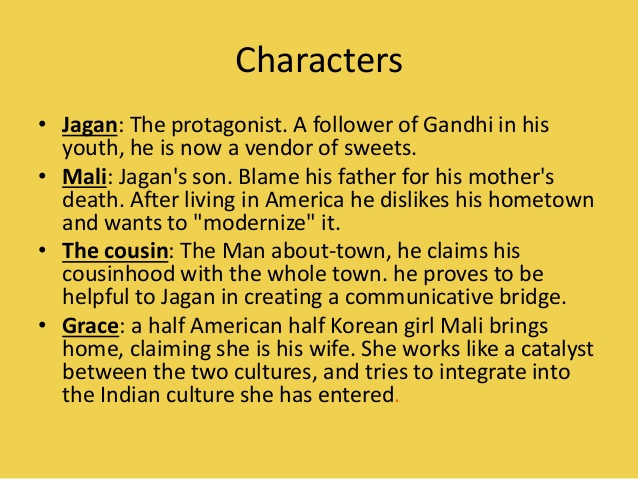
After three years in America, Mali writes that he is arriving home with another person. He appears with Grace, a half-American, half-Korean woman that Jagan assumes is Mali’s wife. Though shocked, Jagan takes a liking to her, as she is warm and kind to Jagan in ways that Mali is not. She tries to take up the duties of a traditional Indian daughter-in-law: cooking, cleaning, and even decorating the house. She transforms Jagan’s house, westernizing it to such an extent that he feels uncomfortable.
Mali expresses his desire to start a factory producing novel-writing machines. It will automate the writing process, making India’s literary output challenge the West. Mali asks for a loan from his father to start the factory. Jagan is horrified at the idea, as he believes that great writing comes from a connection to God. Jagan sees Mali’s machine as an attempt to sever that link. In addition, Jagan comes to suspect that “Grace’s interest, friendliness and attentiveness” are “a calculated effort to win his dollars.” Though he tries to simply ignore the issue, or resist through Gandhian “non-violent non-cooperation,” Mali and Grace force him to give a concrete answer. Jagan instead offers to let Mali take over his sweets shop, but Mali sneeringly responds that “ better plans than to be a vendor of sweetmeats.”
As he is processing Mali’s strange business venture and rejection of his traditional lifestyle, Chinaa Dorai, a sculptor seeking patronage to complete a sculpture of goddess Gayatri, visits Jagan. The sculptor brings him to the isolated grove where he lives and works. As Jagan visits and views the work in progress, he feels that “sweetmeat vending, money and his son’s problems to blur.” When Chinaa Dorai asks if Jagan will buy the grove to support his work, he resists at first but eventually agrees, saying: “Yes, yes, God knows I need a retreat. You know, my friend, at some stage in one’s life one must uproot oneself from the accustomed surroundings and disappear so that others may continue in peace.”
In a discussion with Grace, Jagan soon discovers that she and Mali are not married after all. He is shocked and hurt, feeling that they have tainted his ancestral home. He feels so disconnected from his home and tarnished by his son’s moral laxness that he decides to retire and abandon his home and business and escape to the grove, thus fulfilling the Hindu tradition of Vanaprastha—withdrawal from the material world and passing on of responsibilities to the next generation.
As Jagan prepares to leave, his cousin tells him that Mali has been arrested for drunkenness, violating prohibition laws. Jagan’s resolve to retreat remains unchanged, and he in fact asks that the cousin to do what he can to ensure that Mali stays in prison long enough to learn his lesson. He hands over the keys to the business and sets aside some money for Grace to buy a plane ticket home as he retreats to the grove.
Themes
There are two main themes in Vendor of Sweets: One is the father-son conflict which can be generalized as a conflict between the east and west or between good and evil. The other theme is man’s quest for identity and self-renewal. The protagonist Jagan is a sweet-vendor by profession, follower of the Gita in thinking and talker of Gandian principles but he indulges in double dealing in matters of money, and also cheats sales-tax authorities. He comes to realize that money is evil when his son, Mali, comes back to India with a Korean girl, Grace and asks for money for his business. Jagan finds new life or a new birth in his retirement, when he surrenders his business to his cousin. His fragile Gandhian self-regard collapses before his much-loved son’s strange actions; and after Mali ends up disastrously in prison as a result of driving drunk around Malgudi, Jagan has no option but a Hindu-style renunciation of the world, bewilderment and retreat to a simpler life. But even here his ideal of Sanyasa is not serious as he still holds the purse string.
Settings
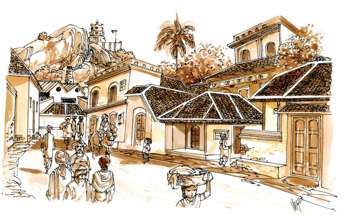
Mulgudi, Narayan’s famous Indian township provides the backdrop for this novel with its interesting mixture of the traditional and colonial heritage.The love and marriage, their devotion to God .and their celebration of the festivals make the Malgudians come alive. The simplicity of the vendor and the naivety of his customers is touching when they spend half an hour discussing politics., before asking for sweet meats and their price.
Characters


Jagan and his son Mali are the main characters and two other minor characters are Jagan’s cousin and the KoreanAmerican girl, Grace. Jagan looks a typical travesty of Mahatma Gandhi dressed in khadi clothes but crazy over money, he cheats the salestax authorities with no scruples and spoils Mali by giving money. Mali, mediocre degenerate usual youth longs to have western way of life like American studies possession of foreign gadgets, consumption of meat, wine and free sex. Jagan represents the superficial aspects of the East and Mali the weaker aspects of the West. A college drop out, Mali attracted by the West contracts relationship with a foreign girl, Grace. Mali rejects his Indian past and tries to imitate Western life. His driving in a drunken state brings him to jail. Jagan-Grace relationship proves that East–West synthesis is also possible. Grace, the unmarried, casteless, foreign girl, has concern and solicitude for Jagan in her attempt to be a good Hindu daughter-in-law. She learns diligently the Indian way of life and maintains the house clean. Jagan on his part understands her predicament brought by the misdeeds of his son. What prevents Grace from settling down in India is not any error on her part, but her money gets exhausted and Mali would have nothing to do with her. Jagan is willing to get her an air ticket if that would be of help to her. Earlier he ignored the ostracisation by his relatives for bringing a foreign lady into the household. But Jagan is not without his weaknesses. He follows Gandhism but cheats income tax people consoling himself that Gandhi did not mention anything about income tax. He reads Gita but cares for caste.
Point of View
In The Vendor of Sweets , Narayan adopts the selective third person point of view. It is the father–son relationship or the conflict of two generations which plays the dominant role in developing the action and shaping the narrative. The experiences and events in the life of both the father and the son, therefore, occupy equal importance in the novel, Narayan, however, focalises the story from the point of view of the father. All the events and happenings in the novel are described as seen through the eyes and mind of Jagan . To provide the full view of Jagan’s life and character, Narayan uses “flash on”and flash back techniques.
Socio-cultural Context
The Western Influence
As western modernity enters Malgudi , its own indigenous values are corroded. Presence of an Insurance company in The Dark Room, , the studio on the bank of river Sarayu in Mr.Sampath, and story writing machine brought by Mali in The Vendor of Sweets indicate that Malgudi is already growing as a civilized commercial centre. Change is not only spatial and temporal but also cultural and social . Mali lives with Grace, an American-Korean even when they are not married. The orthodox Hindu society of Mulgudi, ostracises Jagan for being a Gandhian and punishes Mali for anti-social behavior in the end.
 Literary Globe